Impacted Wisdom Teeth: Understanding The 4 Main Types and When You Need Extraction?
Let me start with a quick, familiar scene.
You’re brushing one night and feel a dull ache at the very back of your mouth.
You ignore it. Fair enough.
A few weeks later, it’s swollen. Chewing feels odd. Your jaw feels tight. Sound familiar?
To be totally honest with you, this is how most people first discover impacted wisdom teeth.
These teeth usually show up in your late teens or early twenties, when the jaw has already settled into its final shape.
And here’s the problem. There’s often just not enough room left for them.
When wisdom teeth don’t come in the right way, they can push, trap food, irritate gums, or stay buried under bone.
That’s when trouble starts.
It could cause pain, swelling or even infections. Sometimes it could even cause damage to nearby teeth.
So, the point of this guide is simple.
We’ll walk you through the four main types of impaction, the impacted wisdom teeth symptoms people usually feel, and how to tell when removal is actually necessary.
Not sure if your wisdom teeth are causing trouble? A quick dental check can give you clarity before pain gets worse.
A] What Are Impacted Wisdom Teeth?
Think of it like this.
A wisdom tooth is meant to grow straight up and settle neatly behind your second molar. But when there isn’t enough space, or the angle is off, it gets stuck.
Basically, what’s happening is the tooth can’t fully break through the gum. Or it grows sideways, forward, or backward instead. That’s what dentists call an “impaction”.
Early on, the signs can be subtle.
A bit of pressure, gum irritation or a sore spot that keeps coming back. Some patients even keep biting the inside of their cheek without knowing why.
Here’s the kicker. You might not see the problem at all. Many impactions sit quietly under the gums for years.
That’s exactly why dental X-rays matter.
According to the American Association of Oral and Maxillofacial Surgeons, nearly 90% of people have at least one wisdom tooth that doesn’t erupt properly. X-rays are often the only way to catch it early.
And that early diagnosis? It can save you from a lot of pain later.
B] The 4 Main Types of Impacted Wisdom Teeth
1. Vertical Impaction
Many consider this as the “best-case scenario”, where the tooth is almost upright and in a nearly normal position.
In many cases, it erupts fully and causes no issues at all. That’s why vertically impacted wisdom teeth treatment often involves monitoring rather than immediate action.
But here’s the reality.
If it presses against the tooth in front or irritates bone at the back of the jaw, removal may still be recommended. When that happens, extraction is usually straightforward and done under local anaesthesia.
2. Mesial Impaction
This is the most common type of case observed, where the tooth tilts forward, leaning into the molar ahead of it.
Sometimes it partially erupts. Part of the tooth shows; part stays trapped under the gum.
When this happens, a small flap of gum tissue (called an operculum) can grow over the partially emerged tooth. This flap easily traps food particles and bacteria underneath it, making the area nearly impossible to clean. Over time, this often leads to localized decay, painful swelling, and infection of the surrounding gum tissue.
In many cases, dentists monitor these teeth to see if they correct themselves.
But when they don’t, that’s when wisdom teeth problems begin.
3. Distal Impaction
This one’s rarer. In this, the tooth tilts backward, toward the rear of the mouth.
If the angle is mild, it may still erupt normally, just with a slight lean. Dentists often wait and watch for a year or two. But if the angle becomes steep, the tooth may hit bone and stop completely. At that point, surgical removal becomes more likely.
4. Horizontal Impaction
This is usually the most painful type.
The tooth lies completely sideways, pushing directly into the neighbouring molar. You won’t see it. Only an X-ray reveals what’s going on. Left untreated, horizontal impacted wisdom teeth problems can include damage to nearby roots and bone loss.
Removal here is more complex and often requires sedation or general anaesthesia. But removing it early can prevent long-term complications.
Five Common Signs of Impacted Wisdom Teeth
If you’re wondering whether something’s off, here are a few red flags dentists see all the time:
- Bleeding or swollen gums at the back of the mouth
- Swelling along the jawline
- Severe pain behind the molars
- Frequent headaches and earaches with no clear cause
- Tender or swollen glands in the neck or shoulders
You shouldn’t brush these wisdom teeth symptoms off, especially if they keep returning.
C] When Do Impacted Wisdom Teeth Need Extraction?
“Do I really need them removed?” A question every dentist hears all the time.
We understand the concern, but the honest answer here is you don’t actually need wisdom teeth. And most jaws simply don’t have space for them.
Regular dental checkups help catch issues early. In many cases, we recommend removal during the eruption phase; since the roots aren’t fully developed yet, the extraction is much easier and results in less trauma for the patient.But sometimes the first clue you should look out for is discomfort or infection. Or some of the classic signs you need wisdom tooth removal that we mentioned earlier, when addressing the symptoms of impacted wisdom teeth.
Let’s break it down.
When a tooth remains trapped, it can grow at odd angles. Sometimes even backward into the jaw. That pressure can lead to stiffness, jaw pain, and difficulty opening your mouth.
Food and bacteria can also get trapped under the gums, leading to inflammation and recurring infections. Over time, cysts can form around impacted teeth. In rare but documented cases, these cysts can damage the jawbone or neighbouring teeth.
And then there’s wisdom tooth decay.
Impacted or partially erupted teeth are notoriously hard to clean. Decay often spreads to the adjacent tooth, which is otherwise healthy.
Patients also report chronic bad breath, a foul taste, or sinus pressure, especially with upper wisdom teeth. Believe it or not, roots can sit dangerously close to the sinus floor.
When these issues show up, impacted wisdom teeth removal isn’t about convenience. It’s about ensuring you don’t face even bigger problems down the line.
D] What to Expect During Extraction and Recovery
Let’s clear up some fear here.
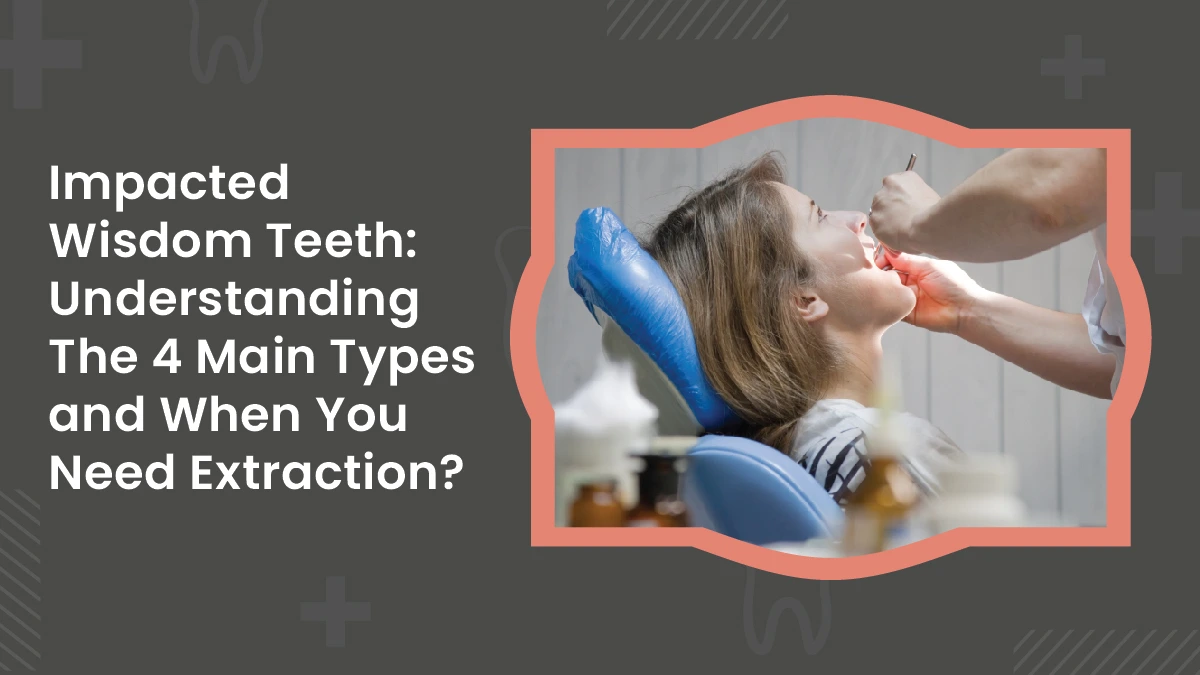
An impacted wisdom tooth extraction usually starts with local anaesthesia. For more complex cases, sedation may be used to keep you comfortable. The dentist or oral surgeon gently removes the tooth, sometimes in sections, and cleans the area.
Swelling typically peaks around day two or three. Most people feel significantly better within a week. Full healing usually takes one to two weeks.
Here are some other care measures you should keep in mind:
- Cold compresses help.
- Soft foods are your friend.
- Avoid smoking and straws, as they can disrupt healing.
You should always keep in mind that gentle oral hygiene keeps infection away. Truth be told, most patients say the anxiety beforehand was worse than the procedure itself.
Experiencing jaw pain, swelling, or discomfort at the back of your mouth? Don’t wait for it to escalate.
Conclusion
Not all wisdom teeth are the same.
The type of impaction determines whether monitoring is enough or whether action is needed.
Some teeth behave. Others don’t. And the earlier you know which camp yours falls into, the better your outcome.
At the end of the day, a simple dental exam and X-ray can give you clarity.
If something doesn’t feel right back there, don’t ignore it. Getting checked early can save you pain, time, and a much bigger procedure down the line.
If you need more information about wisdom tooth extraction treatment in Prabhadevi, get in touch with us. Our team of experienced dentists in Prabhadevi provide a comprehensive evaluation to determine the best course of action for your long-term oral health.
FAQs
In most cases, yes. A horizontal tooth presses against the next molar, as that pressure does not resolve on its own. Over time, it can damage the healthy tooth beside it or trigger repeated infections. If your scan shows contact or crowding, removal is usually the safer call. If it is fully buried and causing no issues, your dentist may choose to monitor it instead.
Your wisdom tooth position falls into one of four patterns:
- Vertical means the tooth is upright but trapped under gum or bone.
- Mesial means it leans forward toward the next tooth.
- Distal means it tilts backward toward the jaw hinge.
- Horizontal means it lies sideways and pushes directly into the adjacent molar.
If you observe any of the following, you should consult your dentist to get a detailed evaluation:
- Pain at the back of your jaw
- Swelling and tenderness around the third molar area
- Recurring bad breath
- Feeling stiff while opening your mouth.
Sometimes you may observe no symptoms at all. However, X-rays will show the real picture. If the tooth has no exit path, removal is often advised even before pain starts.