Root Canal vs Tooth Extraction: Which Treatment Is Better?
We’ve all been there. You’re sitting in the dental chair, your jaw is throbbing, and you just want the pain to stop. When your dentist looks at the X-ray and gives you the choice between a root canal and pulling the tooth, it’s easy to feel overwhelmed. Do you try to save it, or do you just get rid of the problem entirely?
If you are currently experiencing acute pain, seeking a professional root canal service in Prabhadevi can provide a clear diagnosis and a path toward saving your natural smile. It is one of the most common dilemmas patients face.
Many people lean toward extraction because it feels like a "quick fix" or a way to save a few bucks. But is it really that simple? While both procedures are designed to knock out infection and stop your suffering, the long-term impact on your smile is worlds apart. The "better" option isn't just about immediate relief; it’s about how you’ll be chewing and smiling five or ten years from now. Let’s break down the root canal vs. tooth extraction debate so you can make the best choice for your future self.
Need help choosing between root canal and tooth extraction? We’ll guide you.
A] Understanding the Two Treatments: What Actually Happens?
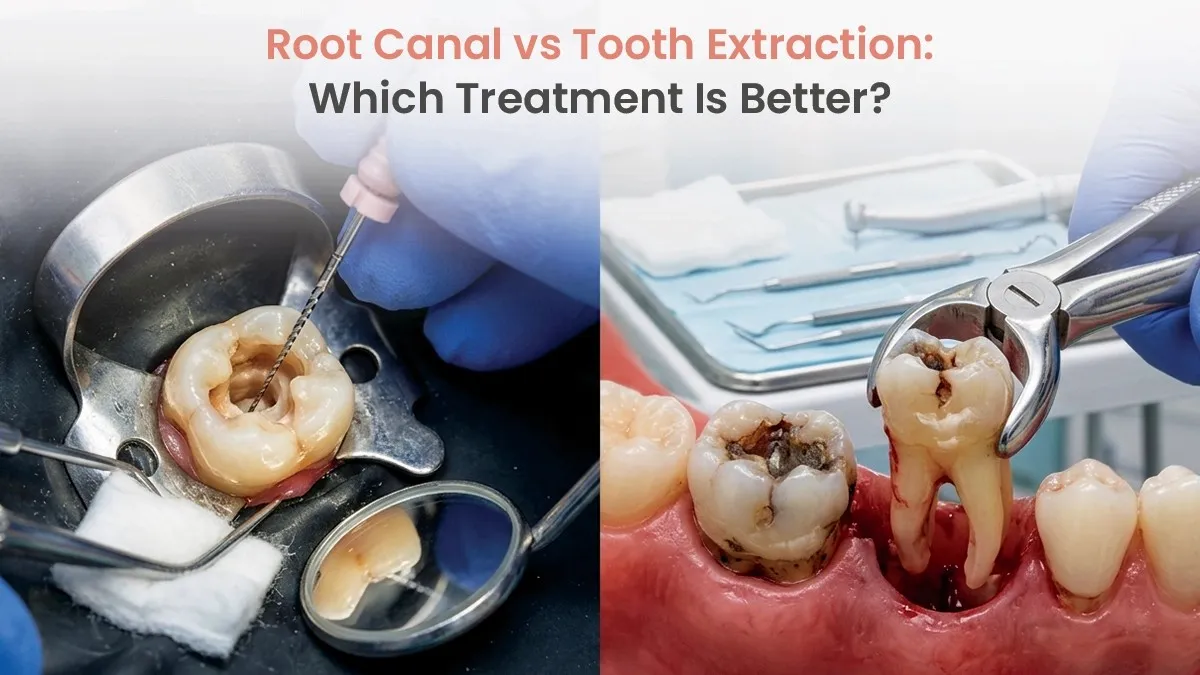
Before we dive into the pros and cons, let’s clear up what these procedures actually involve. Think of it like a house with a termite problem. A root canal is like calling the exterminator to save the structure, while an extraction is like tearing the whole house down.
During a root canal treatment, the goal is to keep your natural tooth right where it belongs. Your dentist removes the "pulp" (the soft tissue inside containing nerves and blood vessels) that has become infected or inflamed. Once the area is cleaned and disinfected, the hollow space is sealed up. Usually, a crown is placed on top to keep the tooth strong.
On the flip side, a tooth extraction is the complete removal of the tooth from its socket. This might be a simple "tug" or a minor surgical procedure if the tooth is tricky to reach. The reality is that while both options get rid of the bacteria causing you grief, the extraction leaves a gap that usually needs to be filled with an implant or bridge.
B] Root Canal vs Extraction: Key Differences That Matter
So, why not just pull it and be done with it? Here’s the kicker: your natural teeth are incredibly efficient machines. No artificial replacement, no matter how high-tech, feels or functions exactly like the tooth you were born with.
1. Function and Feeling
Your natural teeth are connected to your jaw by a specialised ligament that acts like a tiny shock absorber. This gives you sensory feedback when you chew. Essentially, when you keep your tooth via a root canal, your bite remains natural.
2. Bone Health and Facial Structure
Did you know that your jawbone needs the stimulation of your tooth roots to stay healthy? When a tooth is removed, the bone in that area begins to resorb or shrink. Over time, this can actually change the shape of your face, leading to a "collapsed" look. A root canal prevents this by keeping the root in place.
3. The Cost Reality
An extraction can be considered a more cost-efficient option upfront. However, that’s just half the story. If you pull a tooth and don't replace it, your other teeth will start to shift into the empty space, causing bite issues and potential jaw pain. If you do replace it with a high-quality implant, the total cost often ends up being higher than a root canal and a crown combined.
C] When Is a Root Canal the Better Option?
You might be wondering, “is a root canal better or extracting the tooth?”
Most dentists will advocate for a "preservation-first" philosophy, as it comes down to whether the foundation is still solid.
If your tooth structure is mostly intact and the infection hasn't reached the bone in a destructive way, a root canal is almost always the winner. It’s the ideal choice when:
- You want to maintain your natural chewing power.
- The surrounding teeth are healthy, and you don't want to grind them down for a bridge.
- You want to avoid the long, multi-month process of waiting for a dental implant to heal.
Wait until you hear this: according to the American Association of Endodontists, about 15 million root canals are performed every year. Most of these teeth last a lifetime after the procedure. Isn’t it worth a little extra effort to keep what’s yours?
D] When Is Tooth Extraction Necessary?
Sometimes, a tooth is just too far gone. While we love saving teeth, there are moments when fighting for one is a losing battle. Truth be told, forcing a root canal on a failing tooth is a waste of your time and money.
An extraction becomes the right call if:
- You’re weighing a cracked tooth root canal vs. extraction but find that the damage (like a deep vertical fracture) is too severe for the tooth to be saved.
- The decay has destroyed so much of the tooth that there isn't enough "wall" left to hold a crown.
- Advanced gum disease has caused the bone around the tooth to melt away, leaving it loose.
- You’ve already had a root canal on that tooth, and the infection has returned.
In most cases, if a tooth is compromising your overall health, it has to go. But remember: extraction is just the first step of a new journey. You’ll need a plan to fill that gap.
E] What Happens After Extraction? (The Often Overlooked Factor)
It’s completely normal to get caught up in the immediate "ouch" factor. Most people get bogged down in anxiety, asking themselves, "Which is more painful: tooth extraction or root canal?" But here’s the thing: the procedure itself is over in an hour. What happens the day after the tooth is gone? That is the part many people forget to ask about, which brings us to the importance of replacement.
If you decide to remove your tooth instead of root canal therapy, you have to think about the "domino effect". When a tooth is missing, the neighbouring teeth lose their "placeholders" and start to tilt or drift. This can lead to crooked teeth, difficulty cleaning, and eventually, more tooth loss.
To avoid this, you’ll likely look at:
- Dental Implants: The gold standard. A titanium post acts as a new root.
- Bridges: A false tooth held in place by the teeth on either side.
- Dentures: Removable options if multiple teeth are missing.
Which is why it’s so interesting that people choose extraction to "simplify" things, only to find themselves in the dentist's chair for months longer getting an implant fitted.
Don’t ignore tooth pain—get expert advice on root canal vs tooth extraction.
Conclusion
At the end of the day, deciding which is better between a tooth extraction or a root canal isn't a decision you should make based on fear or a quick budget fix. A root canal is an investment in keeping your natural smile, while an extraction is sometimes a necessary medical reset.
The best way to know for sure? Visit our leading dental clinic in Prabhadevi for personalised specialist care, honest clinical breakdowns, and a comfortable, state-of-the-art setting that puts you completely at ease. Our experts can evaluate your case, show you the X-rays, and help you decide what's best for your long-term health.