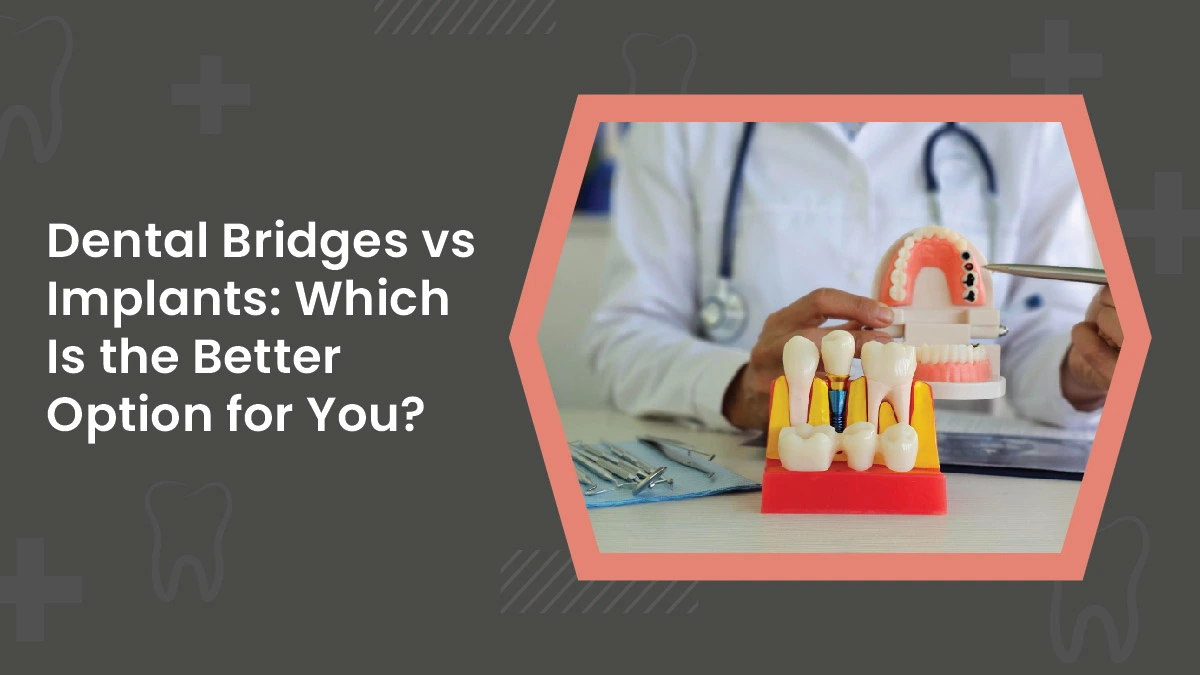
Dental Bridges vs Implants: Which Is the Better Option for You?
Losing a tooth not only alters the natural appearance of your overall facial profile, it also affects how you eat, speak, and smile.
For many people, their confidence takes a severe hit when this happens.
Now, it’s not only about restoring normal function but also about reclaiming your social confidence and preserving your overall quality of life.
When it comes to tooth replacement, dental bridges and implants are both considered excellent restorative solutions.
If you are faced with such a decision, you might be wondering specifically: a tooth implant or a bridge – which is better? While both treatment options can help fill gaps and restore your bite, they differ in cost, durability, procedure, and long-term impact on your oral health.
So which one is better for you?
In this guide, we’ll break down the pros and cons of each, explain how to make the right choice based on your needs, and explore alternative solutions that may fit your lifestyle and budget.
Unsure whether a dental bridge or implant is right for you?
A] Pros and Cons of Dental Bridges
Before choosing either treatment option, it is important to understand the pros and cons of dental implants vs bridges, allowing you to weigh all your options carefully.
Dental bridges (including the single-tooth bridge option) can provide many benefits when it comes to fully recapturing your natural smile and confidence.
Dental Bridges Pros:
Dental bridges provide many benefits when it comes to fully recapturing your natural smile and confidence:
- They can be custom-designed to blend naturally with your existing teeth.
- They will enable you to chew and speak normally again.
- Bridges help ensure that neighbouring teeth do not shift into the gap left behind the missing ones.
- You won’t need to undergo bone grafting or invasive surgery for bridges.
- The process of installing a bridge can usually be completed in two visits, with the appointments spread out over a two-week period.
- The upfront cost of a bridge is lower than that of a dental implant.
One of the main benefits of a bridge is that it can be installed quickly from start to finish.
However, bridges also have certain drawbacks:
- Bridges are not a permanent solution. You will need to get it replaced at some point, typically within seven to fifteen years.
- As part of its process, neighbouring teeth will have to be shaped and fitted with crowns where otherwise they would have required no treatment.
- Patients have often reported more instances of tooth decay or cavities after receiving bridges because it’s difficult to floss and brush around them properly.
It can be a real pain to clean your teeth after receiving a bridge. As three of your teeth are connected, it is almost impossible to get your brush between them.
You can use special tools or flosses to brush beneath a bridge, but that could be another annoying addition to your daily oral routine.
B] Pros and Cons of Dental Implants
Dental implants are gaining in popularity as a tooth replacement option for one missing tooth. Here are some of the benefits of this course of treatment:
- Dental implants retain their natural appearance for a much longer period than dental bridges.
- The implant will never get a cavity.
- You can replace a missing tooth without touching any of the neighbouring teeth.
- Implants are considered a permanent solution and, with proper care, will last for the rest of your life.
While it can be considered a permanent solution, you still need to take proper care to ensure the health of the surrounding gum and bone. The care process for a dental bridge vs an implant is considerably more complicated.
But dental implants also have some drawbacks:
- You will have to undergo a surgical procedure to install the implant. Any such procedure will carry with it risks like nerve damage, infection, improper placement or sinus damage.
- The entire procedure can take as long as six months from start to finish. You will also have to make multiple dental visits to insert the dental implant and crown.
- Dental implants may not be right for you if you're under 18 and your jaw is still growing.
- Dental implants have a higher up-front cost than the cost of a dental bridge. However, they’re a permanent solution that can end up becoming a comparable or lower investment to a bridge over the lifespan of the dental implants.
C] How To Choose Between Dental Bridges and Dental Implants?
You will have to take into account multiple factors before deciding which treatment option is right for you between a tooth implant and a bridge. Sometimes, it boils down to your individual preferences. Ask yourself the following questions:
- How much time can you allocate to the full treatment and healing process?
- What is your desired timeline for completing the tooth replacement?
- How dedicated are you to the ongoing maintenance (cleaning and care) required for the restoration?
- How comfortable are you with undergoing a surgical procedure?
Let’s delve into some of these factors in greater detail.
1. Cost
If your health insurance policy covers dental procedures, it is highly unlikely to include implants, while partial coverage may be provided for a bridge treatment. You will need to evaluate which treatment option fits within your current budget, regardless of whether you have insurance or not. If either or both options are out of your price range, you may need to ask your dentist about alternative options, such as partial dentures or other alternatives.
2. The total number of missing teeth
If you need to replace multiple consecutive teeth, a dental bridge can be considered as one of the options. However, it is important to note that even if several teeth are missing, multiple implants can also be placed in a single sitting during the same surgery. The choice between the two depends on the patient’s needs and the dentist’s evaluation.
3. Overall health
As part of the dental implant procedure, you will be required to undergo surgery. If you suffer from conditions that slow down the healing process, such as leukaemia or diabetes, implants are not the right treatment option for you. The best candidates for this procedure are people who have a strong overall jawbone function and good overall health.
4. Time
As we have mentioned before, the recovery time for a dental bridge vs an implant is significantly lower. A dental implant procedure can take several months to complete from start to finish. A bridge, on the other hand, can be installed in two separate trips to the dentist within two weeks.
During the implant procedure, your oral surgeon will drill into the jawbone to fuse the implant’s root to the bone. They may fit a temporary denture while your bone is healing, but you’ll have to wait between 2 and 6 months before a crown can be placed.
D] Alternative Options Instead of Dental Bridges or Dental Implants
You can opt for alternative treatment options like space maintainers or partial dentures for replacing a missing tooth and don’t have to necessarily choose between a bridge or implant treatment.
1. Partial dentures
Partial dentures are used to fill gaps between one or multiple missing teeth. They are usually composed of metal and plastic. They are clipped to your healthy teeth to keep them in place.
Your dentist might recommend a partial denture if they determine that the teeth around your missing tooth are unable to bear the load of supporting a bridge.
While they may be a more cost-effective option than implants or bridges, they are often less stable or comfortable and can interfere with your ability to speak or eat.
2. Space maintainers
Space maintainers can be a temporary option if you are unable to afford tooth replacement right away. Typically, they are composed of metal and help ensure that the teeth on either side of your missing tooth don’t shift. This is commonly used in children to allow their adult teeth to grow unobstructed and keep the surrounding teeth in place.
Get expert advice on dental implants vs bridges, from procedure to recovery time.
Conclusion
Ultimately, the decision between a dental bridge and an implant will be heavily influenced by your personal preferences and priorities. Both options can restore your smile, but the right choice depends on your oral health, bone structure, budget, and long-term goals.
What is the smartest step you can take?
Consult your dentist for a personalised evaluation. With expert professional guidance, you can select a treatment that not only replaces what’s missing but also restores comfort, function, and confidence for years to come.
For personalised care from an implant specialist in Prabhadevi, consult the best dental clinic in Prabhadevi and book a consultation.